
 By
By 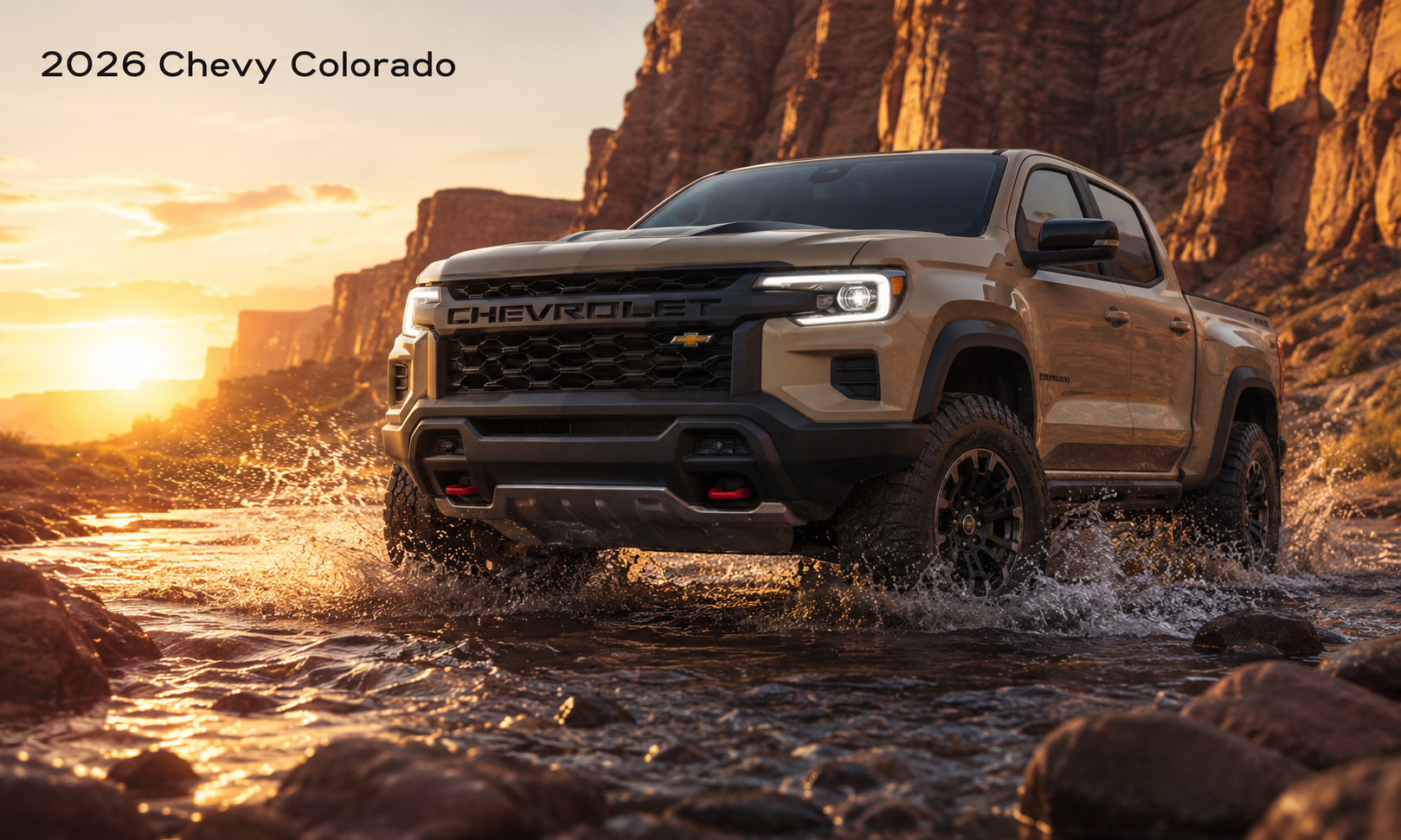
A U.S. buyer guide to trims, towing, off-road capability, pricing, fuel economy, safety, and the smartest Colorado for each type of owner
The 2026 Chevy Colorado does something unusual in the midsize-truck market: it simplifies the powertrain choice while expanding the range of personalities. Every Colorado now centers on Chevrolet’s 2.7-liter TurboMax four-cylinder with 310 horsepower and 430 lb-ft of torque, yet the truck can be configured as a basic rear-drive work pickup, a comfortable daily driver, a 7,700-pound tow rig, or a highly specialized ZR2 Bison on 35-inch tires. For buyers, that means the real decision is no longer which engine to order. It is which chassis, driveline, suspension, tire package, and equipment level best match the job.
The 2026 model year is not a full redesign. The third-generation Colorado arrived for 2023, and Chevrolet largely carries that formula forward for 2026 with modest wheel and color changes plus special-edition content. That is not necessarily a weakness. The current truck already has strong towing numbers, a modern cabin, an 11.3-inch center screen, and some of the most serious factory off-road hardware in the class.
| 310 hp
TurboMax output |
430 lb-ft
Standard torque |
7,700 lb
Max available towing |
11.3 in
Center touchscreen |
Key Takeaways
- The 2026 Colorado uses the 2.7-liter TurboMax engine across the lineup, producing 310 horsepower and 430 lb-ft of torque with an eight-speed automatic.
- Chevrolet lists the WT at $32,400 before destination and related charges. Published delivered-price figures are higher, so compare out-the-door totals rather than headline MSRP alone.
- Maximum available towing is 7,700 pounds on properly equipped configurations, while the ZR2 is rated lower at 6,000 pounds because its off-road setup prioritizes suspension travel and terrain performance.
- Trail Boss is the value-focused off-road choice, Z71 blends off-road hardware with more daily comfort, and ZR2 is the specialist model with Multimatic DSSV dampers, locking differentials, and a 3-inch factory lift.
- ZR2 Bison pushes farther with 35-inch mud-terrain tires, 12.2 inches of ground clearance, hydraulic jounce-control dampers, and extensive AEV skid-plate protection.
- The Colorado is sold only as a crew cab with a short bed, so buyers who need multiple cab or bed lengths should also look at rivals such as the Toyota Tacoma and Nissan Frontier.
Start Here: Which 2026 Colorado Fits Your Job?
Instead of starting with the trim list, it is easier to start with the truck’s actual job. The mechanical similarities between trims make the use case more important than the badge.
| Primary Use | Best Fit | Why It Makes Sense |
| Work sites and value | WT | Lowest-price entry with the same 310-hp TurboMax engine. |
| Style on a tighter budget | Custom | Black wheels and trim add style without a large price jump. |
| Daily commuting and mixed use | LT | More comfort-focused equipment while keeping full truck capability. |
| Affordable off-road use | Trail Boss | 2-inch lift, 32-inch all-terrain tires, 4WD, and trail hardware. |
| Weekdays plus outdoor weekends | Z71 | A stronger blend of trail equipment, lighting, and cabin finish. |
| Serious trail driving | ZR2 | DSSV dampers, locking front and rear differentials, 3-inch lift. |
| Maximum factory off-road use | ZR2 Bison | 35-inch tires, 12.2-inch clearance, jounce dampers, AEV armor. |
How Much Does the 2026 Chevy Colorado Cost?
Chevrolet’s U.S. site currently lists these starting MSRPs before destination, taxes, title, licensing, dealer fees, and options. Chevrolet’s official 2026 Colorado page is the best place to confirm current factory pricing because incentives and equipment availability can change during the model year.
| Trim | Chevrolet Starting MSRP* |
| WT | $32,400 |
| Custom | $33,545 |
| LT | $36,000 |
| Trail Boss | $40,500 |
| Z71 | $44,600 |
| ZR2 | $50,700 |
*Pricing context: Car and Driver lists a 2026 Colorado price range of $34,495 to $62,795, which reflects a delivered-price view and higher-end equipment. This is why shoppers may see a starting figure around $34,500 even though Chevrolet’s base MSRP is $32,400. Always compare the final window sticker and out-the-door quote.
What Is the 2026 Colorado Like With One Standard Engine?
The 2.7-liter TurboMax is the defining mechanical feature of the current Colorado. Its 310 horsepower is competitive, but the more important number for truck buyers is 430 lb-ft of torque. Chevrolet calls that best-in-class standard torque, and the engine delivers the kind of low-rpm pull that matters when merging with a trailer, climbing grades, or carrying weight in the bed.
An eight-speed automatic is standard. Rear-wheel drive is available on the lower trims, while the off-road-focused versions use four-wheel drive. Chevrolet does not offer a V6 or diesel in the 2026 Colorado. The lack of multiple engine choices makes ordering simpler, but buyers who specifically want a hybrid powertrain should look at the Toyota Tacoma i-FORCE MAX, while shoppers wanting a naturally aspirated V6 can still find one in the Nissan Frontier.
Can the 2026 Chevy Colorado Really Tow 7,700 Pounds?
Yes, but only when the specific truck is properly equipped. Chevrolet advertises a maximum available trailering rating of 7,700 pounds. That is one of the Colorado’s strongest practical advantages in the midsize segment. The figure is not universal across every configuration, however, and the ZR2 is capped at 6,000 pounds.
For real towing, the truck’s door-jamb payload label, hitch rating, axle ratings, tire load limits, passenger weight, cargo, accessories, and trailer tongue weight all matter. A 7,700-pound advertised maximum does not mean every owner should hook up a 7,700-pound trailer without calculating the complete load. Buyers towing near the upper end should prioritize a non-ZR2 configuration with the proper trailering equipment and integrated trailer-brake hardware.
| Capability Check | What to Know |
| Max available towing | 7,700 lb when properly equipped |
| ZR2 towing | 6,000 lb maximum |
| WT payload reference | Up to about 1,846 lb in a representative 2WD configuration; exact payload varies by truck |
| Bed setup | Crew cab with short bed only |
| Tailgate | Available StowFlex storage; mid-position tailgate can support up to 500 lb |
Trail Boss, Z71, ZR2, or Bison: How Far Off-Road Do You Actually Go?
Trail Boss: The value play
Trail Boss is the easiest off-road trim to justify for buyers who want visible and functional upgrades without paying ZR2 money. It gets a 2-inch factory lift, 32-inch all-terrain tires, four selectable drive modes, a two-speed automatic transfer case, and underbody protection. For dirt roads, trailheads, snow, sand, and moderate trails, this is a lot of capability for the price.
Z71: The balanced choice
Z71 sits between Trail Boss and ZR2. It keeps the 32-inch all-terrain tires and trail-oriented drive modes but adds more premium visual and lighting details. It is the Colorado to consider if the truck will spend most weekdays on pavement and weekends on rougher terrain. For many U.S. buyers, this is the most balanced trim in the lineup.
ZR2: The hardware-first off-roader
ZR2 is not simply an appearance package. It gets a 3-inch factory lift, 33-inch mud-terrain tires, Multimatic DSSV dampers, front and rear locking differentials, five selectable drive modes, wider stance, skid plates, and available underbody cameras. Car and Driver recorded 0 to 60 mph in 6.8 seconds in a ZR2, showing that the heavier off-road equipment does not make the truck feel slow.
ZR2 Bison: Maximum terrain, more compromise
The Bison package is for buyers who know why they need it. Developed with American Expedition Vehicles, it brings 35-inch mud-terrain tires, 12.2 inches of ground clearance, five boron-steel skid plates, and front and rear hydraulic jounce-control dampers. Those upgrades improve clearance and protection, but they also come with a higher price, lower fuel economy, and the same reduced ZR2 towing ceiling. It is an off-road specialist, not the default best Colorado.
What Fuel Economy Should Buyers Expect?
Fuel economy varies significantly by drivetrain and tire package. Car and Driver reports EPA estimates ranging from 16 to 19 mpg city and 16 to 24 mpg highway across the lineup. Rear-wheel-drive models are the most efficient at about 19 city and 24 highway, while mainstream 4WD configurations are around 17 city and 22 highway. ZR2 is roughly 17 mpg across the board, and the 35-inch-tire Bison falls to about 16 mpg city and highway.
That spread matters. A buyer choosing a Bison for its look but commuting 20,000 miles per year will pay a meaningful fuel penalty compared with a WT, Custom, or LT. The right trim is therefore partly an annual operating-cost decision, not just a purchase-price decision.
Is the Colorado Comfortable Enough for Daily Use?
Yes, with one qualification: it is still a midsize body-on-frame pickup. The front seats and driving position work well for long trips, and the cabin feels much more contemporary than the previous-generation Colorado. The rear seat is usable for adults but tighter than what buyers coming from a full-size crew cab may expect.
Every 2026 Colorado benefits from a modern screen layout. Chevrolet lists an 11.3-inch center touchscreen with Google built-in, Apple CarPlay and Android Auto compatibility, plus an 11-inch digital Driver Information Center. Depending on trim and options, buyers can add wireless charging, a trailering app, multiple camera views, and underbody camera views on the serious off-road models.
The bed also gets practical details that are easy to overlook in a showroom, including up to 17 available tie-downs, an available 120-volt outlet, bed lighting, a built-in measurement tool, and available StowFlex tailgate storage.
What Does the 2026 Colorado Offer for Safety?
Standard Chevy Safety Assist includes Forward Collision Alert, Automatic Emergency Braking, Front Pedestrian Braking, Lane Keep Assist with Lane Departure Warning, a Following Distance Indicator, and IntelliBeam automatic high beams. Those features are useful, but crash-test detail is more mixed than a simple checklist suggests.
The Insurance Institute for Highway Safety 2026 Colorado ratings show Good ratings in the small-overlap front and updated side tests, but a Marginal rating in the updated moderate-overlap front test. IIHS also rates the standard vehicle-to-vehicle front crash-prevention system Poor under its newer test protocol and pedestrian front crash prevention Acceptable. Safety-focused shoppers should consider the full test record, not only the presence of standard driver-assistance features.
What Changed for the 2026 Chevy Colorado?
The answer is intentionally short: not much mechanically. The 2026 truck carries over the core third-generation formula. Car and Driver notes modest revisions to wheel and paint choices rather than a major redesign or powertrain overhaul. Chevrolet also highlights new wheel choices for Trail Boss and Z71 and offers the Stars & Steel special edition on Trail Boss with American-flag-inspired graphics and black appearance hardware.
That makes the 2026 model a good candidate for comparison shopping against a discounted 2025. If two trucks have equivalent equipment and warranty start dates, a remaining 2025 could be the stronger value. Buyers should compare incentives rather than assuming the newer model year is automatically worth more.
How Does the 2026 Colorado Compare With Its Main Rivals?
| Truck | Powertrain Angle | Towing Headline | Best Reason to Consider |
| Chevy Colorado | 310 hp / 430 lb-ft standard | Up to 7,700 lb | Strong standard torque, towing, ZR2 off-road depth |
| Ford Ranger | Turbo four; Raptor adds twin-turbo V6 | Up to 7,500 lb | Comfortable road manners, Raptor performance |
| Toyota Tacoma | Turbo four; hybrid available | Varies by configuration | Broad body/trim choice, available hybrid, strong off-road range |
| Nissan Frontier | 3.8L naturally aspirated V6 | Up to about 7,150 lb | Simple V6 appeal, multiple cab/bed combinations |
| Honda Ridgeline | Naturally aspirated V6, AWD | Lower than body-on-frame leaders | Best road manners and everyday cabin utility for many buyers |
For an independent benchmark and current pricing context, see Car and Driver’s 2026 Chevrolet Colorado review. It rates the Colorado 9/10 and places it among the stronger current midsize pickups, while also noting the limitation of a single crew-cab and short-bed configuration.
Who Should Buy a 2026 Chevy Colorado?
- Buy it if you want strong towing and torque without moving up to a full-size Silverado.
- Buy it if you want factory off-road capability that scales from mild Trail Boss hardware to the extreme ZR2 Bison.
- Buy it if a crew cab and short bed fit your life and you do not need a long-bed or extended-cab configuration.
- Think twice if maximum fuel economy is a priority, especially if you are attracted to the ZR2 or Bison mainly for appearance.
- Think twice if you need hybrid efficiency, a naturally aspirated V6, or more cab-and-bed combinations. Rival trucks cover those needs better.
- Compare a 2025 before buying because the 2026 changes are modest and leftover inventory may carry stronger incentives.
Questions Buyers Commonly Ask About the 2026 Colorado
Does the 2026 Chevy Colorado have a V6?
No. Every 2026 Colorado uses Chevrolet’s 2.7-liter TurboMax four-cylinder. It produces 310 horsepower and 430 lb-ft of torque and is paired with an eight-speed automatic transmission.
What is the best 2026 Colorado trim for most people?
LT is the practical daily-driver choice, while Z71 is the stronger all-around pick for buyers who want real off-road ability without the price and compromises of a ZR2. Trail Boss is the value option for owners who prioritize capability over cabin upgrades.
Is the ZR2 worth the extra money?
It is worth it when the buyer will use the hardware. Multimatic DSSV dampers, locking front and rear differentials, a 3-inch lift, 33-inch mud-terrain tires, and specialized drive modes are meaningful upgrades. For ordinary commuting and light dirt-road use, Z71 or Trail Boss usually makes more financial sense.
What is the difference between ZR2 and ZR2 Bison?
Bison adds AEV-developed equipment for more extreme terrain, including 35-inch mud-terrain tires, 12.2 inches of ground clearance, five boron-steel skid plates, and hydraulic jounce-control dampers. It is the most terrain-focused Colorado and also one of the least efficient.
Can the 2026 Colorado tow a travel trailer?
Potentially, yes. Properly equipped configurations are rated up to 7,700 pounds, but travel-trailer shopping must be based on the exact truck’s payload label, tongue weight, passengers, cargo, hitch equipment, and the trailer’s loaded weight rather than dry weight alone.
Is the 2026 Colorado a good value?
It can be, especially in LT, Trail Boss, and Z71 form. The same 310-hp engine and 430 lb-ft torque rating across the range means lower trims do not feel mechanically shortchanged. Value becomes more subjective in heavily optioned ZR2 and Bison configurations, where the price approaches larger trucks and specialty rivals.
Final Verdict: The Colorado Is Best When You Buy the Trim for the Job
The 2026 Chevy Colorado is not the midsize truck with the most configurations, the most engines, or the best fuel economy. Its strength is concentration. Chevrolet gives every buyer a high-torque 310-hp engine, modern screens, solid core safety equipment, and a five-seat crew-cab body, then changes the truck’s mission through driveline, suspension, tires, differentials, and equipment.
That makes the shopping logic unusually clear. WT and Custom are for buyers who want capability at the lowest price. LT is the everyday truck. Trail Boss is the off-road bargain. Z71 is the balanced adventure trim. ZR2 is the serious trail machine. Bison is for the smaller group of owners who genuinely need maximum clearance and protection.
For most U.S. buyers, Z71 is the trim to test first and LT is the trim to price-check against it. If towing is the priority, stay focused on properly equipped non-ZR2 configurations. If off-road performance is the priority, decide whether you actually need ZR2 hardware before paying for it. That one decision can save thousands of dollars and produce a Colorado that fits daily life better.







Comments