Category: Car Reviews

  • 2026 Lamborghini Urus Price: What Will You Actually Pay?

    2026 Lamborghini Urus Price: What Will You Actually Pay?

    A U.S. price guide covering the Urus SE, options, taxes, ownership costs, performance, charging, and ultra-luxury SUV alternatives

    The published Lamborghini Urus 2026 price starts at $252,007 according to Car and Driver. That figure is best treated as an entry point, not a realistic final budget. Destination charges, paint, wheels, carbon-fiber trim, upgraded seating, audio, driver-assistance equipment, personalization, sales tax, registration, and dealer pricing can push an actual 2026 Urus SE above $300,000.

    The 2026 lineup is simpler than earlier model years because the plug-in hybrid Urus SE is the only regular U.S. version. The gasoline-only Urus S and Urus Performante are no longer part of the 2026 lineup. Buyers should also avoid confusing the 2026 SE with the newer Urus SE Performante, which is positioned for the 2027 model year.

    Key Takeaways

    Car and Driver lists the 2026 Lamborghini Urus from $252,007, but published pricing varies by source and included fees.

    A realistically configured Urus SE can easily reach roughly $290,000 to $350,000 or more before tax.

    The 2026 model uses a 789-hp plug-in hybrid powertrain with a twin-turbo V-8, an electric motor, an eight-speed automatic, and all-wheel drive.

    The Urus SE offers an EPA-estimated 35 miles of electric range and uses an 11-kW onboard charger.

    Ownership budgeting should include premium fuel, charging equipment, insurance, tires, carbon-ceramic brakes, taxes, registration, storage, and depreciation.

    The safest buying method is to compare the signed factory configuration, window sticker, dealer fees, and out-the-door price rather than relying on one advertised number.

    Why Do Published 2026 Urus Prices Differ?

    Luxury and exotic-car pricing is not always displayed consistently. One source may list a base vehicle price, another may include destination, and another may use a market-data feed based on vehicles that already contain popular equipment. Lamborghini also offers extensive Ad Personam personalization, so two new Urus SE models can have dramatically different stickers.

    Price Layer Typical Meaning What Buyers Should Do
    Published starting figure Entry price before many options and local costs Use it only for initial budgeting
    Factory-configured MSRP Base vehicle plus paint, interior, wheels, packages, and destination Match it to the signed configuration sheet
    Dealer asking price May equal MSRP or include a markup, discount, or required accessories Request every adjustment in writing
    Out-the-door price Vehicle price plus tax, registration, documentation, and products Use this number to compare dealers
    Total financed cost Out-the-door price plus interest over the loan term Compare APR, term, down payment, and total interest

    The same vehicle can therefore appear to start near $252,000 on one guide while a highly optioned dealership example carries a sticker above $310,000. That does not automatically mean the dealer added a six-figure markup. Much of the difference may come from factory personalization, although buyers should verify every line.

    What Is a Realistic 2026 Urus SE Budget?

    Buying Scenario Practical Vehicle Budget Who It Fits
    Near-base configuration $252,000 to $280,000 Buyer limiting personalization and optional equipment
    Well-optioned build $290,000 to $330,000 Typical buyer choosing premium paint, wheels, cabin upgrades, and technology
    Heavy Ad Personam build $340,000 and above Buyer prioritizing rare colors, carbon fiber, custom upholstery, and exclusive details
    Out-the-door total Varies by state Adds tax, registration, documentation fees, and optional products

    These are budgeting ranges rather than official trim prices. The only reliable way to price a specific Urus is to review the factory configuration and dealer buyer’s order. A vehicle with expensive paint, exposed carbon fiber, 23-inch wheels, upgraded leather, rear bucket seats, premium audio, and multiple assistance packages can move far beyond a basic guide price.

    How Much Can Sales Tax Add?

    Sales tax alone can change the transaction by tens of thousands of dollars. At a hypothetical 6 percent tax rate, a $252,007 purchase creates about $15,120 in tax before registration and fees. A $320,000 build creates about $19,200 in tax. Actual rules vary by state, county, trade-in credit, registration location, and whether luxury or personal-property taxes apply.

    Do not assume that registering the vehicle in another state automatically eliminates tax. Exotic-car registration structures can create legal, insurance, residency, and audit problems. Buyers should use a qualified tax professional and follow the law of the state where the vehicle is principally garaged and used.

    What Does the 2026 Urus SE Include?

    The 2026 Urus SE combines a twin-turbocharged 4.0-liter V-8 with an electric motor. Total output is 789 horsepower and 701 lb-ft of torque. Power reaches all four wheels through an eight-speed automatic transmission.

    Specification 2026 Lamborghini Urus SE
    Powertrain Twin-turbo 4.0-liter V-8 plus electric motor
    Combined output 789 hp and 701 lb-ft
    Transmission 8-speed automatic
    Drivetrain All-wheel drive
    Claimed 0 to 60 mph About 3.4 seconds
    Car and Driver estimate Approximately 2.9 seconds
    Top speed 194 mph
    EPA-estimated EV range 35 miles
    Maximum towing Up to 7,000 pounds with the proper hitch setup
    Seating Four or five, depending on configuration

    The official Lamborghini Urus SE model page lists 800 metric horsepower, a 3.4-second 0-to-62-mph time, and a 194-mph top speed. U.S. horsepower figures use a different measurement convention, which is why American publications commonly describe the system as producing 789 hp.

    Does the Plug-In Hybrid System Save Money?

    The hybrid system can reduce gasoline use during short trips, but fuel savings are not the main financial reason to buy a Urus SE. The battery provides about 35 miles of EPA-estimated electric range, which may cover local errands or a short commute when the vehicle is charged regularly.

    A depleted battery can be replenished with the 11-kW onboard charger, and a full Level 2 charge takes roughly four hours. DC fast charging is not available. Owners who do not install home charging may use the plug-in system far less often and will miss much of its daily-efficiency benefit.

    The SE is rated around 20 mpg combined when operating as a hybrid, but actual results depend heavily on speed, driving mode, battery charge, climate, and throttle use. Repeated high-performance driving can produce fuel consumption that looks very different from the official estimate.

    Which Options Can Raise the Price Most?

    • Ad Personam exterior paint and special color development
    • Carbon-fiber exterior packages, mirror caps, spoilers, and interior trim
    • Large forged wheels and specialized performance tires
    • Premium leather, contrast stitching, embroidery, piping, and custom color combinations
    • Four-seat rear bucket configuration instead of the standard rear bench
    • Upgraded audio, driver-assistance, night vision, and parking technology
    • Panoramic roof, heated and ventilated seating, and additional comfort features
    • Protective film, ceramic coating, tint, storage accessories, and dealer-installed equipment

    Options should be evaluated in three ways: personal enjoyment, replacement cost, and resale appeal. A rare color may make the vehicle special to its first owner but reduce the next buyer pool. Carbon fiber and large wheels can improve appearance while making cosmetic repairs and tire replacement more expensive.

    What Will the Urus Cost to Own?

    Cost Category Why It Matters
    Insurance A 789-hp exotic SUV has high repair values, theft exposure, and liability risk
    Fuel and charging Premium gasoline is required, and home Level 2 equipment may be useful
    Tires Large high-performance tires can be expensive and may wear quickly
    Brakes Carbon-ceramic hardware performs well but can be costly if replacement is needed
    Maintenance Specialized labor, fluids, diagnostics, and parts cost more than mainstream SUV service
    Registration and tax Some states charge value-based registration or annual personal-property tax
    Depreciation A small percentage loss on a $300,000 vehicle can equal a large dollar amount
    Storage and transport Secure parking, battery care, detailing, enclosed shipping, or seasonal storage may add expense

    Lamborghini provides a three-year warranty with unlimited mileage and five years of complimentary scheduled maintenance on newer models, according to Car and Driver. Wear items, tires, cosmetic damage, track use, and many optional services remain the owner’s responsibility.

    Should You Finance, Lease, or Pay Cash?

    Cash removes interest expense but places a large amount of capital into a depreciating asset. Financing preserves liquidity but can create substantial interest charges, especially when the loan is long or the down payment is small. Leasing may reduce resale uncertainty, although exotic-car lease terms can require a significant upfront payment and strict mileage or condition standards.

    Compare the total cost, not the monthly payment. A lower monthly figure can hide a balloon payment, long term, large down payment, mileage limit, acquisition fee, or expensive money factor. Buyers should also confirm whether the lender requires specific insurance limits, tracking devices, secure storage, or appraisal documentation.

    How Does the Urus Price Compare With Rivals?

    Model Approximate U.S. Position Why Buyers Cross-Shop It
    Audi RS Q8 Performance Far less expensive Related engineering, strong speed, and more discreet styling
    Porsche Cayenne Turbo E-Hybrid Lower starting price Plug-in V-8 performance with a broader trim range
    Aston Martin DBX707 Similar ultra-performance market Distinctive design and powerful twin-turbo V-8
    Bentley Bentayga Luxury-focused alternative Craftsmanship, comfort, and broad personalization
    Ferrari Purosangue Much more expensive Naturally aspirated V-12 and greater exclusivity
    Mercedes-AMG G63 Less expensive but still costly Iconic design, strong resale demand, and off-road heritage

    The Urus does not win a price comparison against the Audi or Porsche. Its justification is emotional: Lamborghini styling, sound, brand identity, customization, and supercar-like presence in an SUV body. Buyers focused mainly on performance per dollar have less expensive options.

    Should You Buy New or Used?

    A new Urus SE provides the newest hybrid system, factory configuration control, full warranty coverage, and the ability to order a specific color and interior. The downside is the highest purchase price and first-owner depreciation.

    A used Urus S or Performante can cost less and may offer a more traditional gasoline-only experience, but it will not have the SE’s electric range or hybrid torque. Used buyers should inspect service records, tire age, carbon-ceramic brakes, wheel damage, paintwork, underbody condition, software history, and evidence of track or launch-control use.

    A pre-purchase inspection at a Lamborghini dealer or experienced exotic-car specialist is essential. A clean vehicle-history report cannot reveal every repaint, wheel repair, over-rev event, storage issue, or deferred service item.

    How Can You Avoid an Overpriced Urus?

    1. Obtain the VIN, factory configuration sheet, and original window sticker.
    2. Separate factory options from dealer-installed products and market adjustments.
    3. Request a written out-the-door price before visiting the showroom.
    4. Compare at least two authorized Lamborghini dealers when inventory allows.
    5. Get a VIN-specific insurance quote before placing a nonrefundable deposit.
    6. Review financing and lease terms using total cost rather than monthly payment.
    7. Confirm the deposit, cancellation, allocation, delivery, and price-change terms in writing.

    The official Lamborghini dealer locator can help buyers identify authorized U.S. retailers and compare available allocations or inventory.

    Frequently Asked Questions

    How much is a 2026 Lamborghini Urus?

    Car and Driver lists a starting price of $252,007. Actual configured vehicles may be substantially more expensive.

    Which Urus model is sold for 2026?

    The regular 2026 lineup consists of the plug-in hybrid Urus SE. The former gasoline-only S and Performante are discontinued for this model year.

    Can a 2026 Urus cost more than $300,000?

    Yes. Factory personalization, carbon fiber, wheels, interior upgrades, technology, destination, taxes, and dealer pricing can push the total well above $300,000.

    How much horsepower does the Urus SE have?

    The plug-in hybrid system produces 789 U.S. horsepower and 701 lb-ft of torque.

    How far can the Urus SE drive on electricity?

    The EPA-estimated electric range is approximately 35 miles.

    Does the Urus SE qualify as an efficient SUV?

    It is more efficient than the former gasoline-only Urus in certain use cases, but it remains a heavy, high-performance luxury SUV.

    Is the 2027 Urus SE Performante the same as the 2026 Urus SE?

    No. The SE Performante is a newer, more track-focused version associated with the 2027 model year.

    The Bottom Line

    The 2026 Lamborghini Urus starts near $252,000 according to the reference guide, but most buyers should budget well above that number. A well-equipped Urus SE can approach or exceed $300,000 before taxes, and extensive personalization can take the total much higher.

    The best buying strategy is to ignore vague advertised prices and compare the exact factory build, dealer adjustment, state taxes, financing, insurance, and long-term operating costs. The Urus SE offers extraordinary performance and real SUV practicality, but its financial commitment extends far beyond the base MSRP.

  • 2026 Ford Mustang Convertible Review and Price

    2026 Ford Mustang Convertible Review and Price

    EcoBoost versus GT Premium, manual versus automatic, roof operation, performance, fuel economy, comfort, options, and the best configuration

    2026 Mustang convertible fact Details
    Convertible lineup EcoBoost Convertible, EcoBoost Premium Convertible, and GT Premium Convertible
    EcoBoost engine 2.3-liter turbocharged four-cylinder with 315 hp and 350 lb-ft
    GT engine 5.0-liter V8 with 480 hp and 415 lb-ft
    Optional GT exhaust output 486 hp and 418 lb-ft with active valve performance exhaust
    EcoBoost transmission 10-speed automatic only
    GT transmissions Six-speed manual with rev matching or optional 10-speed automatic
    GT Premium MSRP $58,575 on the supplied specification page
    EcoBoost Premium starting MSRP $41,845 on Ford’s current 2026 lineup page
    Drivetrain Rear-wheel drive
    Dimensions 189.4 inches long, 81.9 inches wide, and 55 inches tall
    Verdict in 30 seconds

    The EcoBoost is the better everyday convertible because it is less expensive, lighter on fuel, and still quick. The GT Premium is the emotional choice, combining open-air driving with a naturally aspirated V8 and an available manual transmission. Choose the GT only when the engine sound and performance justify roughly $17,000 or more in additional purchase cost.

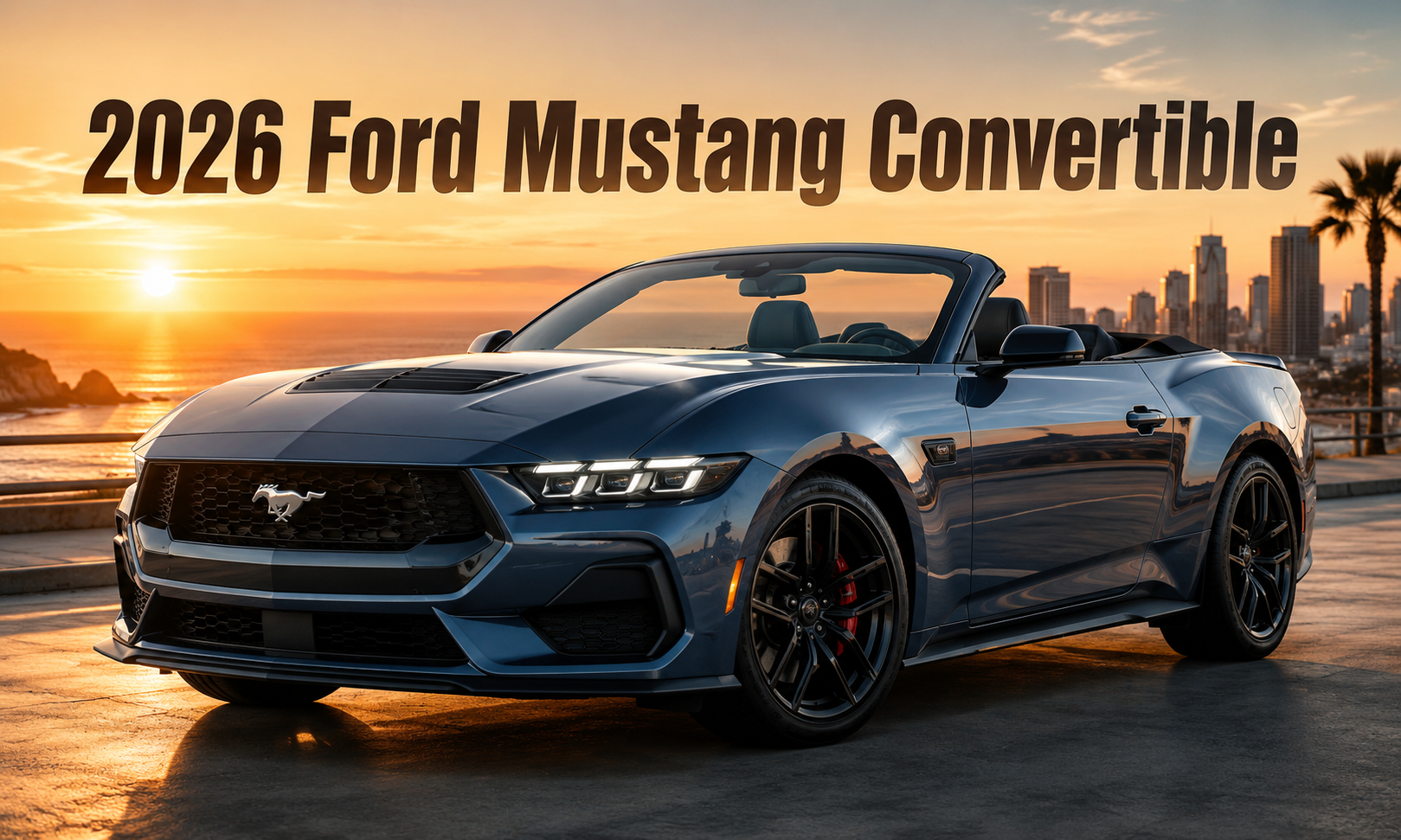
    2026 Ford Mustang convertible is available in three main forms, giving buyers a choice between an efficient turbocharged four-cylinder and a traditional V8. The convertible is not offered in the standard GT trim, so V8 buyers must step up to the better-equipped GT Premium.

    The open-air Mustang is designed more for road trips, commuting, and scenic driving than maximum racetrack performance. Removing the fixed roof adds weight and reduces structural stiffness, but the trade is a power-operated soft top and a driving experience that no fastback can duplicate.

    2026 Mustang Convertible Lineup and Pricing

    Model Starting price Power Best buyer
    EcoBoost Convertible Below Premium pricing; verify current sticker 315 hp Value-focused open-air buyer
    EcoBoost Premium Convertible About $41,845 315 hp Best everyday choice
    GT Premium Convertible $58,575 480 or 486 hp V8 enthusiast

    Ford’s current 2026 Mustang lineup page confirms three convertible models, 315 hp for the EcoBoost, 480 hp for the standard GT V8, new colors, and the available FX Package on the GT Premium Convertible.

    EcoBoost Convertible: The Rational Choice

    The 2.3-liter EcoBoost makes 315 horsepower and 350 lb-ft of torque on 93-octane fuel. It comes only with the 10-speed automatic, which makes it easy to drive in traffic and keeps the engine in its strongest range during acceleration.

    The EcoBoost Premium is the most balanced version because it adds ActiveX seating material, heated and cooled front seats, a heated steering wheel, ambient lighting, available premium audio, and a more upscale cabin without the GT’s fuel and insurance costs.

    Choose the base EcoBoost Convertible only when its lower transaction price is meaningful and the exact vehicle includes the technology and comfort features you need. Dealer inventory may favor Premium versions.

    GT Premium Convertible: The Emotional Choice

    The GT Premium uses Ford’s 5.0-liter Coyote V8, producing 480 horsepower and 415 lb-ft. The available active valve performance exhaust raises output to 486 horsepower and 418 lb-ft while allowing the driver to adjust exhaust volume.

    The supplied Car and Driver 2026 GT Premium Convertible specification page lists a $58,575 MSRP, rear-wheel drive, port and direct fuel injection, 480 horsepower at 7,150 rpm, and 415 lb-ft at 4,900 rpm.

    A six-speed manual is standard and includes automatic rev matching. The 10-speed automatic is optional and will generally deliver quicker, more repeatable acceleration. The manual is the better fit for drivers who see shifting as part of the convertible experience.

    EcoBoost Versus GT Premium

    Decision point EcoBoost Premium GT Premium
    Starting price About $41,845 $58,575
    Engine character Strong low-rpm turbo torque Naturally aspirated V8 sound and revs
    Transmission 10-speed automatic only Manual or 10-speed automatic
    Fuel cost Lower Substantially higher
    Insurance and tires Usually lower Usually higher
    Best use Commuting and touring Performance and weekend driving
    Resale appeal Broad convertible audience Strong enthusiast interest

    Performance and Handling

    The Mustang fastback provides the cleanest performance numbers, but the convertible remains quick. Current testing of comparable Mustangs shows the EcoBoost can reach 60 mph in the mid-four- to mid-five-second range depending on equipment and testing method, while an automatic GT can enter the low-four-second range.

    The convertible’s additional weight and reduced rigidity make it less precise than the coupe during aggressive cornering. Buyers can still add the GT Performance Package, MagneRide adaptive dampers, upgraded brakes, wider wheels, and summer tires to the GT Premium.

    Do not overbuild a street convertible

    The Performance Package and summer tires improve grip, but they also raise price, tire cost, ride firmness, and cold-weather limitations. A standard GT Premium with active exhaust may be the better road car.

    Soft-Top Operation and Practicality

    The power-operated fabric roof can be lowered for open-air driving and includes a rear glass window. The driver must still plan around weather, luggage, security, and rear visibility. A soft top is less insulating than a fixed metal roof, although modern seals and lining keep the cabin reasonably comfortable.

    The rear seats are best for children, short trips, or extra storage. Trunk capacity is smaller than the fastback’s, and the opening can be restrictive for large luggage. Buyers should test their regular bags before purchase.

    Ownership issue Convertible reality What to check
    Weather sealing Good when maintained Water leaks after a wash
    Roof fabric Durable but exposed Cuts, abrasion, fading, and loose stitching
    Rear visibility Reduced with roof raised Camera clarity and mirror adjustment
    Trunk space Limited Fit luggage with roof in normal position
    Wind noise Higher than fastback Drive at 70 mph with roof raised
    Rear seat Very tight Passenger fit before buying

    Interior and Technology

    The cabin combines a 12.4-inch digital instrument cluster with a 13.2-inch touchscreen. Premium versions can add a magnesium-framed curved display, heated and cooled seats, a heated steering wheel, ambient lighting, and a 12-speaker B&O audio system.

    Ford Co-Pilot360 technology includes common driver-assistance functions, while available Co-Pilot360 Assist+ can add adaptive cruise control, stop-and-go capability, lane centering, and speed-assistance features. Availability depends on model and package.

    What Is New for 2026?

    • New Avalanche Gray, Adriatic Blue Metallic, and Orange Fury Metallic Tri-coat exterior colors
    • New FX Package for GT Premium Fastback and Convertible
    • Oxford White wheels, badges, and interior details with the FX Package
    • Spoiler delete included for convertible models
    • Revised standard wheel finish
    • Updated mirror equipment on selected standard package levels

    Fuel Economy and Ownership Cost

    The EcoBoost is the clear efficiency winner. Exact EPA ratings depend on configuration, but it consumes significantly less fuel than the 5.0-liter V8. The GT also carries higher insurance, rear-tire, brake, and potential gas-guzzler costs.

    Both engines can produce their maximum rated output on premium fuel. Buyers should verify the owner’s manual and fuel door for minimum requirements. A driver covering 12,000 miles annually can spend hundreds more each year operating the GT, even before insurance.

    Which Version Should You Buy?

    Buyer type Best choice Reason
    Daily commuter EcoBoost Premium Lower fuel and purchase cost
    First convertible EcoBoost Premium Strong equipment and manageable power
    Manual enthusiast GT Premium manual Only convertible with a clutch pedal
    Fastest road car GT Premium automatic Quicker, more consistent acceleration
    Sound-focused buyer GT Premium with active exhaust Adjustable V8 character
    Style-focused buyer GT Premium with FX Package Distinctive white design details

    Frequently Asked Questions

    How much is the 2026 Mustang convertible?

    The EcoBoost Premium Convertible starts around $41,845, while the GT Premium Convertible is listed at $58,575. A base EcoBoost Convertible is also available.

    Does the convertible come with a V8?

    Yes. The GT Premium Convertible uses a 5.0-liter V8 with 480 horsepower, or 486 horsepower with active exhaust.

    Can you get a manual convertible?

    Yes, but only the GT Premium Convertible offers the six-speed manual. EcoBoost convertibles use a 10-speed automatic.

    Is the GT convertible faster than the EcoBoost?

    Yes. The V8 has substantially more power and stronger acceleration, although the EcoBoost remains quick.

    Is the convertible practical for daily driving?

    It can be, especially in EcoBoost Premium form. Rear-seat room and trunk space are limited, and soft-top security requires extra care.

    Which trim is the best value?

    The EcoBoost Premium is the best overall value. The GT Premium is worth the premium for buyers who specifically want the V8 or manual transmission.

    Final Verdict

    The 2026 Mustang Convertible offers two distinct personalities. The EcoBoost Premium is a comfortable and reasonably affordable open-air cruiser with enough speed for everyday fun. The GT Premium adds the sound, response, and emotional appeal of a V8, but it costs much more to buy and operate.

    Choose the EcoBoost Premium when the convertible experience matters more than maximum power. Choose the GT Premium manual when shifting and V8 character define the experience, or the automatic when acceleration and convenience matter most.