
 By
By 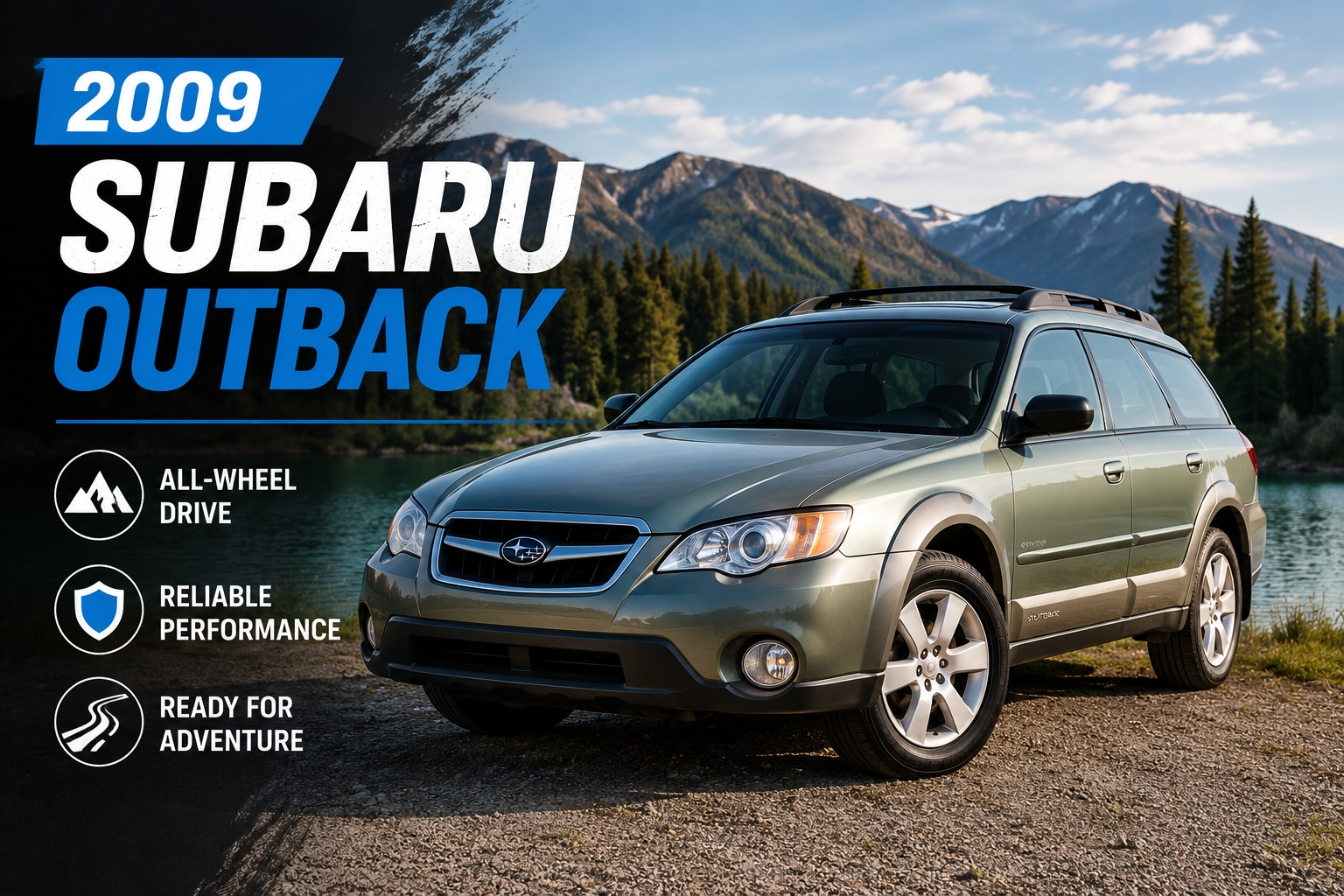
Specs, trims, current value, common age-related risks, and what to inspect before buying one today
The 2009 Subaru Outback sits in an interesting place in the used-car market. It is old enough that condition matters far more than trim badges, yet modern enough to offer standard all-wheel drive, useful cargo space, respectable crash-test results for its era, and a choice of three very different boxer-engine personalities. For shoppers in 2026, the question is no longer whether the 2009 Outback was good when new. The better question is whether a specific 17-year-old example has been maintained well enough to be a smart buy now.
The original Car and Driver 2009 Subaru Outback specifications list the base manual 2.5i at $22,990 when new, with standard all-wheel drive, 8.4 inches of ground clearance, 33.5 cubic feet of cargo room behind the rear seat, and 66.2 cubic feet with the rear seat folded. Those numbers still explain the car’s appeal, but a 2026 purchase should be driven by service history, rust, engine choice, recall status, and inspection results.
Key Takeaways
- The 2009 Outback came with a 2.5-liter non-turbo four-cylinder, a turbocharged 2.5XT, or a 3.0-liter six-cylinder, and the ownership experience differs significantly among them.
- The naturally aspirated 2.5-liter is the simplest and most common choice, but documented timing-belt service and checks for oil or coolant leaks matter more than low mileage alone.
- The 3.0R uses a timing chain rather than the four-cylinder timing belt and delivers smoother power, while the 2.5XT is the enthusiast option but deserves the most careful mechanical inspection.
- Late-July 2026 Kelley Blue Book estimates put typical fair-purchase values roughly from under $2,000 to around $5,750 depending on trim and condition, though unusually clean, low-mileage or manual examples can trade outside those averages.
- Because 2009 Outbacks fall within Subaru model years affected by Takata air-bag recalls, buyers should check the VIN for open recalls before purchase.
Checkpoint 1: Which 2009 Outback Are You Actually Looking At?
The nameplate covered several mechanically distinct versions. Treating every 2009 Outback as the same car is one of the easiest ways to misjudge price, maintenance needs, and long-term running costs.
2.5i, Special Edition, and Limited: 2.5-liter naturally aspirated flat-four, about 170 hp, with a 5-speed manual or 4-speed automatic. Best for buyers prioritizing simpler, lower-cost ownership.
2.5XT Limited: Turbocharged 2.5-liter flat-four with 243 hp, offered with a 5-speed manual or 5-speed automatic. Best for enthusiasts who accept higher inspection and maintenance risk.
3.0R Limited: 3.0-liter flat-six with 245 hp and a 5-speed automatic. Best for buyers who want smoother highway power and a timing-chain engine.
For context, period specifications put the turbo 2.5XT at 243 hp and the 3.0R at 245 hp, while the regular 2.5-liter engine produced about 170 hp. The numbers are close at the top, but the character is not. The XT feels quicker and more boost-driven, while the six-cylinder 3.0R is smoother and more linear.
Checkpoint 2: Does the Base 2.5i Still Make Sense?
For most 2026 shoppers, the naturally aspirated 2.5i is still the rational place to start. It is less complicated than the turbo model, runs on regular fuel, and parts familiarity is excellent because Subaru used related 2.5-liter boxer engines across many vehicles of the era.
The base manual car was rated at 22 mpg combined, 20 city and 26 highway in the Car and Driver specification listing. Those figures are modest by current standards, but the tradeoff is standard all-wheel drive and unusually useful ground clearance for a wagon-shaped vehicle.
What matters most now is not the EPA number. It is whether the engine has a credible maintenance story. On four-cylinder versions, ask for proof of timing-belt service. A seller who says “it has low miles, so the belt is fine” is missing the age factor. Rubber components age even when a vehicle is not driven much.
Checkpoint 3: What Should You Know About the Timing Belt, Head Gaskets, and Oil Leaks?
The 2.5-liter four-cylinder engines use a timing belt, while the 3.0-liter six-cylinder uses timing chains. On a 2009 four-cylinder car in 2026, timing-belt history should be treated as a purchase-document question, not a future maintenance reminder. If there is no invoice, sticker, or reliable service record showing replacement, budget for the job and have the related idlers, tensioner, and water pump evaluated at the same time.
Also inspect the engine carefully for external oil seepage and coolant leaks. Older Subaru flat-fours from this period have a reputation for gasket-related leaks, but the severity varies widely from one car to another. A dry, well-maintained 150,000-mile car can be a better buy than a neglected 90,000-mile car that has spent years sitting.
During a pre-purchase inspection, ask the technician to look for fresh oil residue around the cylinder-head area, coolant staining, overheating history, mixed or contaminated fluids, valve-cover leakage, power-steering leaks, and evidence that the engine bay was recently washed to hide seepage.
Checkpoint 4: Is the 2.5XT Worth the Extra Risk?
The 2.5XT Limited is the version enthusiasts remember. Its turbocharged 2.5-liter engine makes 243 hp and 241 lb-ft of torque, and it could be paired with a five-speed manual. It is considerably more interesting to drive than the base car, but age changes the buying equation.
A 17-year-old turbo Subaru should be purchased on condition and documentation. Look for regular oil changes, correct oil level, evidence of sensible warm-up and cool-down habits, no persistent smoke, stable boost behavior, and no signs of amateur engine tuning. Modified cars are not automatically bad, but a heavily modified XT with incomplete records is a very different risk from a stock example owned by the same person for a decade.
If you want a 2.5XT because it is the quickest version, pay for a Subaru-specialist inspection. The extra inspection cost is small compared with the cost of solving a turbocharger, engine, clutch, or drivetrain problem after purchase.
Checkpoint 5: Why Do Some Buyers Prefer the 3.0R?
The 3.0R Limited is the quiet alternative to the XT. Its naturally aspirated flat-six makes 245 hp and 215 lb-ft of torque and comes with a five-speed automatic. It is not as tuner-oriented as the turbo car, but it has a strong following because of its smooth power delivery and timing-chain design.
The tradeoffs are fuel cost and complexity. The 3.0R was designed for premium fuel, and its six-cylinder layout can make some service jobs tighter and more labor-intensive. In return, buyers avoid the scheduled timing-belt replacement that applies to the four-cylinder versions.
For someone who wants an older Outback primarily for highway driving, winter traction, and a more relaxed engine, a clean 3.0R can be more appealing than chasing the lowest-priced 2.5i.
Checkpoint 6: What Is a 2009 Subaru Outback Worth in 2026?
Current value depends heavily on location, mileage, rust, maintenance, and whether the car is being sold privately or by a dealer. Kelley Blue Book’s 2009 Outback valuation page showed the following national estimates for vehicles in “Good” condition, valid through July 24, 2026. These figures should be treated as a reference point, not a guaranteed transaction price.
| Trim example | Trade-in | Private party | Fair purchase price |
| 2.5i Limited Wagon 4D | $625 | $1,550 | $1,925 |
| 2.5i Wagon 4D | $2,050 | $3,500 | $4,075 |
| 3.0R Limited Wagon 4D | $2,650 | $4,975 | $5,625 |
| 2.5XT Limited Wagon 4D | $2,725 | $5,075 | $5,750 |
Why can two apparently similar cars be thousands of dollars apart? At this age, records and condition create the premium. A rust-free manual car with documented timing-belt work, fresh tires, no warning lights, a clean interior, and one or two long-term owners can command more than an average guide value. A cheap car with corrosion, overdue maintenance, mismatched tires, or overheating history can become expensive very quickly.
Checkpoint 7: How Important Are Tires on an Older Subaru AWD System?
Very. Subaru’s all-wheel-drive system is one of the reasons people seek out older Outbacks, but it also means tire condition should be judged as a set. Check that all four tires are the same size, ideally the same model, and have closely matched tread depth. Large circumference differences can create unnecessary stress in the AWD system.
Look underneath the car as well. In snowy regions, inspect rear subframe areas, suspension mounting points, brake and fuel lines, exhaust components, rocker areas, and wheel arches for corrosion. Surface rust is common on an older northern car; structural rust or heavily scaled mounting points are a different matter.
Checkpoint 8: Which Recalls Should You Check Before Buying?
Do not rely on the seller saying that “all recalls were done.” Check the VIN yourself. NHTSA lists 2003 through 2014 Subaru Outbacks among model years affected by the Takata air-bag recall campaign, although whether a specific car has an open recall depends on its VIN and repair history.
Use the NHTSA recall lookup before purchase and enter the 17-character VIN. Recall repairs are performed free by the manufacturer’s dealer network when an open safety recall applies.
Checkpoint 9: What Should a Pre-Purchase Inspection Cover?
- Cold start: listen for abnormal knocking, rattling, exhaust leaks, belt noise, or rough idle.
- Cooling system: verify stable temperature, correct coolant level, clean fluid, and no evidence of repeated overheating.
- Engine and transmission: check for leaks, delayed engagement, clutch slip on manual cars, harsh shifts, and warning lights.
- AWD and tires: confirm matched tires, even wear, no binding in tight turns, and no wheel-bearing growl.
- Suspension and steering: inspect struts, bushings, ball joints, CV boots, tie rods, and power-steering components.
- Rust: inspect underneath, not just visible body panels.
- Brakes: check rotor condition, pedal feel, parking brake operation, and brake-line corrosion.
- Electronics and interior: test the climate system, windows, locks, heated seats where equipped, sunroof, audio, and every warning lamp during key-on.
- Service records: prioritize documented major work over vague claims such as “maintained regularly.”
What Is the 2009 Outback Still Good At?
The old Outback’s strengths are easy to understand even in 2026. It has a relatively low roof compared with many modern crossovers, a long and useful cargo area, standard AWD, good outward visibility, and 8.4 inches of ground clearance on the base specification. It can handle winter commuting, camping gear, dogs, bikes, and rough access roads without feeling like a large SUV.
Its weaknesses are equally clear. Fuel economy is dated, infotainment is basic, modern active-safety systems are absent, road and wind noise are more noticeable than in a new Outback, and age-related repairs can overwhelm the value of a neglected example.
Who Should Buy One in 2026?
A 2009 Subaru Outback makes the most sense for a buyer who wants inexpensive AWD utility and is comfortable maintaining an older vehicle. It is particularly attractive as a second car, winter car, outdoor-use wagon, first enthusiast project, or low-cost alternative to a newer crossover when the specific example is solid.
It makes less sense for someone who needs a completely predictable appliance with minimal maintenance risk. At 17 years old, even a good Outback may need suspension pieces, wheel bearings, seals, hoses, brakes, sensors, or age-related rubber components simply because of time.
Frequently Asked Questions
Is a 2009 Subaru Outback reliable?
It can be, but reliability now depends more on the individual car than the model-year reputation. A documented, rust-free car with completed timing-belt service on four-cylinder models is a much safer bet than a lower-mileage car with no records.
How many miles can a 2009 Outback last?
There is no guaranteed lifespan. Many examples exceed 150,000 or 200,000 miles, but reaching high mileage economically depends on maintenance, rust exposure, overheating history, oil level, and how quickly repairs were handled.
Does the 2009 Outback have a timing belt or chain?
The 2.5-liter four-cylinder versions use a timing belt. The 3.0-liter six-cylinder uses timing chains.
Is the 2009 Outback good in snow?
Its standard all-wheel drive and 8.4 inches of ground clearance are strong advantages, but winter performance still depends heavily on tire quality. AWD helps the car move; winter tires also help it turn and stop.
Which 2009 Outback engine is best?
For lower-cost ownership, the non-turbo 2.5-liter is the usual choice. For smooth power, the 3.0R is appealing. For performance and enthusiast value, the 2.5XT is the standout, but it deserves the strictest inspection and maintenance history.
Is a cheap 2009 Outback worth buying?
Only if the inspection supports the price. A $2,000 car that immediately needs a timing-belt service, tires, wheel bearings, brakes, and leak repairs may cost more than a $4,500 example that already had those jobs completed.
The Bottom Line
The 2009 Subaru Outback is no longer a car you should buy by model reputation alone. In 2026, it is a condition-first purchase. The best examples still offer a practical mix of AWD traction, wagon cargo space, ground clearance, and mechanical character for relatively little money. The worst examples can hide enough deferred maintenance to exceed their purchase price in repairs.
Start by identifying the engine and transmission, verify timing-belt history where applicable, inspect for leaks and rust, check all four tires, run the VIN through NHTSA, and pay for a pre-purchase inspection. If those checkpoints are clean, a 2009 Outback can still be a useful and genuinely enjoyable old-school Subaru.





Comments