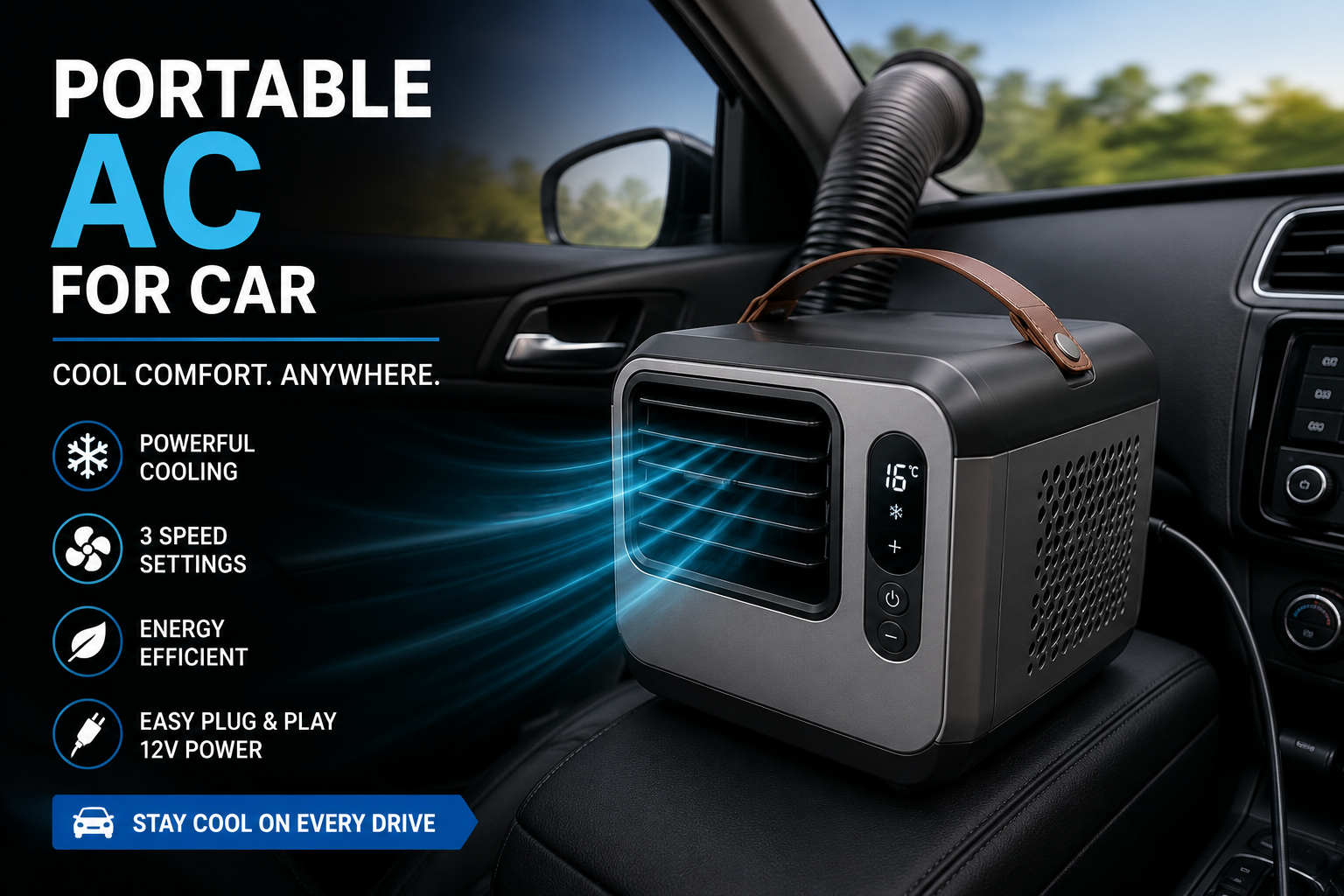
Compressor units, evaporative coolers, 12-volt fans, power requirements, venting, safety, and better alternatives when factory A/C fails
| Cooling type | Can lower air temperature? | Works while driving? | Best use |
| Factory vehicle A/C | Yes | Yes | Best solution for normal driving |
| Compressor portable A/C | Yes, when properly vented | Usually impractical | Parked camper, van, or stationary vehicle setup |
| Evaporative cooler | Sometimes in dry air | Limited personal relief | Dry climates and direct airflow |
| 12V fan | No | Yes | Air circulation and faster sweat evaporation |
| Ice-box cooler fan | Brief local cooling | Limited | Short personal relief, not cabin cooling |
| Garage portable A/C | Yes in a vented room | No | Garage or workshop, not a moving car |
| The short answer
A true portable AC for a car must use a compressor, reject heat outside the cabin, and receive far more power than a normal 12-volt accessory outlet can provide. Small water-filled devices and fans may make one person feel cooler, but they normally cannot cool an entire sun-heated vehicle. |
Portable AC for car is a confusing product category because many inexpensive listings are fans or evaporative coolers rather than real air conditioners. A genuine A/C removes heat from the cabin and sends that heat outside. Without an exhaust path, a compressor unit would release the removed heat back into the same space.
For a car with broken factory air conditioning, a plug-in gadget is rarely an equal replacement. The vehicle’s built-in system has the airflow, compressor capacity, sealed ducts, and power supply required to cool a glass-heavy cabin exposed to direct sunlight. Portable products work best for personal airflow or specialized stationary setups.
The Reference Products Are Garage Units, Not Car Units
The supplied Car and Driver portable garage air-conditioner test evaluated six floor-standing units for garages and rooms. Its top choices included the Whynter 14,000-BTU model, Midea Duo 12,000-BTU model, and Black+Decker 12,000-BTU model.
Those machines weighed roughly 59 to 74 pounds and consumed about 823 to 1,004 watts on maximum cooling. They also required a standard 120-volt outlet and an exhaust hose routed through a window or opening. Those requirements make them unsuitable for ordinary in-car use while driving.
| Tested garage unit | Cooling rating | Power draw | Why it does not fit normal car use |
| Whynter dual hose | 9,500 SACC / 14,000 ASHRAE BTU | About 998 W | 74 lb, dual hoses, wall-level power |
| Midea Duo | 10,000 SACC / 12,000 ASHRAE BTU | About 1,004 W | 69 lb, exhaust hose, 120V outlet |
| Black+Decker | 8,000 SACC / 12,000 ASHRAE BTU | About 823 W | 59 lb, single exhaust hose, high current demand |
Why a 12-Volt Outlet Cannot Power Strong A/C
A typical vehicle accessory outlet is commonly limited to around 120 to 180 watts. A room-style compressor A/C may need five to eight times that amount while running, plus a brief startup surge. Plugging such a unit into a small inverter can blow a fuse, overheat wiring, shut down the inverter, or drain the battery.
A battery power station can operate some compressor A/C units, but runtime depends on battery capacity and cooling load. A 1,000-watt unit drawing from a 2,000-watt-hour battery may run for well under two hours after conversion losses and compressor cycling. Solar input rarely keeps pace with full cooling demand unless the installation is large.
| Never idle a gasoline vehicle in an enclosed garage
Running the engine to power air conditioning or an inverter can create deadly carbon monoxide. Use vehicle climate control only in a properly ventilated outdoor location and follow local anti-idling rules. |
Portable Cooling Options Compared
| Option | What it does | Strength | Limitation |
| Clip-on 12V fan | Moves cabin air | Cheap and easy to mount | Does not reduce air temperature |
| Rechargeable fan | Direct personal airflow | Portable and independent of car power | Limited runtime and cabin effect |
| Evaporative cooler | Blows air across water or a wet pad | Can feel cooler in dry climates | Adds humidity and weakens in humid weather |
| Ice-box fan | Moves air across ice or frozen packs | Noticeably cold air at close range | Short duration and condensation |
| Compressor camping A/C | Actively removes heat | Real cooling when vented correctly | Large, expensive, power hungry |
| Factory A/C repair | Restores designed system | Best whole-cabin performance | Repair cost may be high |
Do Evaporative Car Coolers Work?
Evaporative coolers can reduce the temperature of the air they blow when humidity is low because water absorbs heat as it evaporates. Their effect becomes much weaker in humid climates, and they usually cool only the air immediately around the user.
Inside a closed car, the device also adds moisture. As cabin humidity rises, evaporation slows and the cooling effect declines. Wet surfaces, spilled water, mold growth, and reduced windshield clarity can become concerns.
Use an evaporative device as a personal cooler, not as proof that a parked vehicle is safe. It should never be relied on to protect a child, older adult, pet, or sleeping occupant from heat.
When a Compressor Portable A/C Makes Sense
A compact compressor A/C can make sense in a parked camper van, work van, truck sleeper, or converted SUV when the vehicle has a safe exhaust opening, enough battery capacity, secure mounting, condensation management, and proper ventilation.
The setup should be designed for stationary use. A heavy unit and battery must be restrained so they cannot become projectiles in a crash. Exhaust hoses should not block required exits, and electrical cables must be sized for the load.
| Use case | Recommended solution | Reason |
| Normal daily driving | Repair factory A/C | Best performance and safest integration |
| Temporary commute relief | High-output fan plus sunshade | Affordable while arranging repair |
| Dry-climate personal cooling | Small evaporative cooler | May improve comfort at close range |
| Parked camper or sleeper | Compressor camping A/C and power station | Can deliver genuine cooling when vented |
| Garage workspace | Room-style portable A/C | Matches the supplied reference products |
| Child or pet safety | Never rely on a portable device | Human supervision and removal from the car are essential |
How to Choose a Portable Cooling Device
- Confirm whether the product uses a compressor or only water and a fan.
- Check continuous watts, startup surge, plug type, and required voltage.
- Calculate battery runtime using realistic power draw and conversion losses.
- Verify how hot exhaust air and condensation leave the vehicle.
- Choose a unit that can be secured during travel and stored safely.
- Read the operating-temperature range and humidity limits.
- Avoid products that promise whole-cabin cooling from a tiny USB connection.
Better Ways to Keep a Car Cooler
A reflective windshield shade, legal window tint, shaded parking, ventilated seat covers, light-colored interior surfaces, and remote preconditioning can reduce the initial heat load. Opening doors briefly before entering can release trapped hot air, after which the factory system can cool more efficiently.
NHTSA advises checking A/C performance and the cabin air filter before summer travel. Review NHTSA’s summer driving guidance for air-conditioning, cooling-system, tire, battery, fluid, and roadside-kit checks.
Hot-Car Safety Is Nonnegotiable
A portable fan or cooler must never be used as permission to leave a child or pet unattended. Parked vehicles heat rapidly, and cracked windows or shade provide little protection. Battery devices can stop, tip over, lose power, or fail without warning.
If a person appears distressed in a locked hot vehicle, call 911 immediately. Heat illness can progress quickly, particularly in children, older adults, and people with medical conditions.
| Portable cooling is for comfort, not life support
No consumer fan, ice cooler, or small battery device should be trusted to keep an unattended parked vehicle safe. Always remove occupants from the car. |
Frequently Asked Questions
Can a portable AC cool an entire car?
A properly vented compressor unit can cool a small stationary vehicle space, but most 12V and USB products cannot cool the entire cabin.
Will a portable AC work through the cigarette lighter?
Most true compressor units require more power than a standard accessory outlet can safely provide.
Is an evaporative cooler the same as air conditioning?
No. It uses water evaporation and works best in dry air. It does not refrigerate and dehumidify like a compressor A/C.
Can I use a room portable A/C in a van?
Only in a stationary, carefully vented setup with adequate power and secure mounting. It is not appropriate loose inside a moving vehicle.
What is the best temporary fix for broken car A/C?
Use a strong fan, sunshade, cooler travel times, and open windows when safe, then repair the factory system as soon as possible.
Can I leave a pet in the car with a portable cooler?
No. Devices can fail, and a parked vehicle can become dangerous very quickly.
Final Verdict
The best portable cooling solution depends on the goal. A fan is useful for airflow, an evaporative cooler can provide personal relief in dry weather, and a compressor camping A/C can cool a properly vented stationary van or sleeper.
For ordinary driving, repairing the vehicle’s factory A/C remains the safest and most effective answer. The large garage units in the reference test are powerful and well suited to workshops, but their weight, power draw, and exhaust requirements make them impractical inside a normal car.
Leave a Reply